https://sabsacourses.com/wp-content/uploads/2021/02/TSI-T100-Modelling-SABSA-with-ArchiMate.pdf
Business Attributes represent the ideal, essential qualities desired by the Stakeholders of a system which must be protected and / or enhanced in the material world implementation if the enterprise is to fulfil its mission. They are essential to the SABSA approach but have no direct equivalent in ArchiMate.
At closer examination however, the definition of ArchiMates’s Principle element as “an intended property of a system … a general property that applies to any system in a certain context … motivated by some goal or driver” is semantically compatible for modelling SABSA Business Attributes in the security overlay.
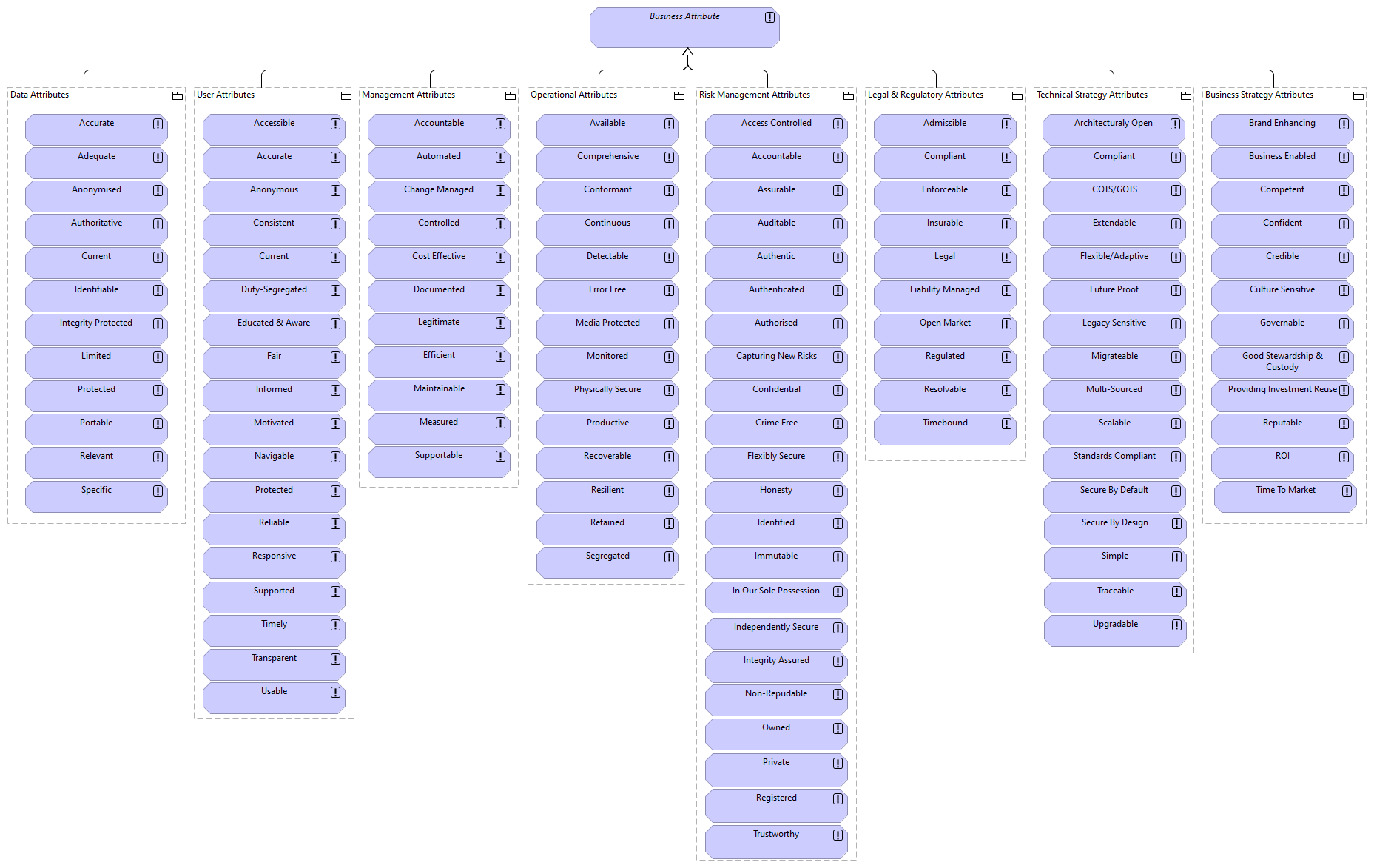
At the root element of this taxonomy, SABSA Business Attribute has been modelled as an abstract stereotype (indicated by <<Italics within Double Chevrons>>). This stereotyping is intended to distinguish SABSA Business Attribute and its concrete sub-types from conventional uses of Principle in EA, such as “Buy before Build” or “Cloud First”.
The taxonomy has been structured using six abstract sub-domains of the root. This is a design choice that may not be strictly necessary and could have been implemented differently – e.g. a visual grouping that would have retained the taxonomical structure while retaining a flat internal model, but ultimately,
it is implemented this way to enable manageability and constraint. It offers potential benefits in practical modelling and in various analysis scenarios such as:
• The domains act as a namespace that allows the construction of qualified names. This not only enables attributes to be overloaded, with appropriate definition & metrics, in different contexts but also appear on the same diagram. For example, Usable might be reused to represent similar system characteristics in a User, Management or Operations context;
• To encourage consistency & correctness in modelling, the formal structure can be used to ensure that Legal or Compliance stakeholders may only be associated with Legal & Compliance attributes;
Another essential requirement of SABSA Attribute modelling is the ability to trace their refinement through the architectural layers. Attributes are abstract concepts: singletons, in a taxonomy that can be reused across models, projects and enterprises. When connected by ‘concrete’ relationships in a model, they also become connected in the abstract: universally and forever.